B2B ecommerce software architecture is the structural framework of technologies, integrations, and data layers that enables enterprise buyers and sellers to transact digitally at scale.
This guide covers architectural patterns and their trade-offs, unified data layers for workflow efficiency, API-driven integration strategy, complex pricing and catalog management, scalability and security requirements, and platform consolidation for omnichannel operations.
Architectural patterns range from monolithic systems suited to simpler deployments through headless, microservices, composable, and API-first designs that give enterprises flexibility to scale individual components independently. Composable commerce in particular has gained rapid adoption, letting organizations swap best-of-breed components without rebuilding entire stacks or accepting vendor lock-in.
Unified data layers consolidate customer, order, and inventory records into a single source of truth, eliminating the channel silos that cost enterprises significant annual revenue through integration failures and duplicated effort. When every buyer interaction resolves to one record across ten or more touchpoints, automation and personalization become structurally possible rather than aspirational.
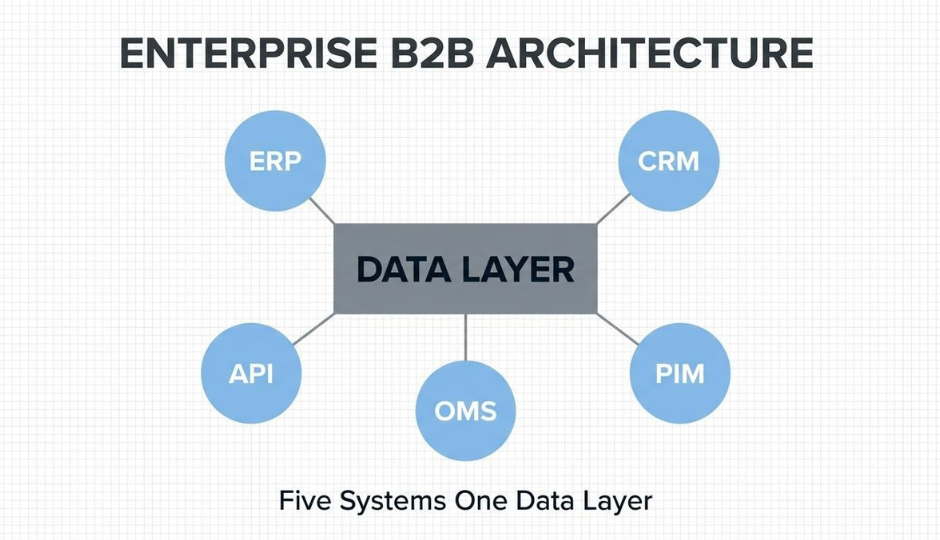
APIs serve as connective tissue between ERP, CRM, PIM, and OMS platforms, enabling real-time synchronization that reduces query latency and eliminates redundant data transformations. An API-first approach future-proofs the platform against evolving integration demands without requiring custom point-to-point connections for each new tool.
Enterprise architecture must also handle contract-specific pricing engines, customer-specific catalogs, multi-region deployment, and elastic scaling during demand spikes; all while meeting SOC 2 and PCI DSS 4.0 compliance requirements at the structural level.
Platform consolidation, where commerce, CRM, and marketing live in one system, removes the compounding integration complexity that fragmented tool stacks produce as organizations grow across channels and regions.
B2B ecommerce software architecture is the structural framework of technologies, integrations, and data layers that enable enterprise buyers and sellers to transact digitally. Below, the key distinctions from B2C systems and the core components of enterprise-grade platforms are outlined.
B2B architecture differs from B2C ecommerce architecture in its handling of multi-party transactions, complex pricing logic, and organizational buying workflows. Where B2C platforms serve individual consumers with fixed pricing and simple checkout flows, B2B systems must support contract-specific pricing, tiered discounts, multi-level approval workflows, and role-based access control across buying teams. B2B catalogs are often customer-specific, showing different products and prices per account. Order volumes tend to be higher per transaction but lower in frequency, requiring architecture optimized for large basket sizes and negotiated terms rather than high-velocity impulse purchases.
The core components of enterprise-grade B2B ecommerce architecture include:
According to a 2025 IDC study, companies using modern B2B editions achieved a 391% three-year return on investment and an 82% improvement in platform stability. These components, when unified under a shared data layer rather than fragmented across disconnected tools, form the operational backbone that separates enterprise-grade systems from basic storefronts.
Understanding these foundational elements clarifies why architectural decisions directly shape enterprise operational outcomes.
Software architecture matters for enterprise B2B operations because it determines how efficiently complex workflows scale, how reliably systems integrate, and how quickly organizations adapt to market demands. The subsections below are integrated into the parent H2 discussion.
B2B ecommerce operates at a scale and complexity level where architectural decisions directly dictate operational outcomes. Global B2B ecommerce site sales reached $2.3 trillion in 2024, according to BigCommerce, and are projected to surpass $3 trillion by 2028. That growth trajectory places enormous pressure on the underlying systems processing multi-step approval workflows, contract-specific pricing, and high-volume orders across regions.
Architecture shapes three critical operational dimensions:
The operational cost of getting architecture wrong compounds quickly. Failed integrations cost organizations an average of $2.5 million in direct costs plus opportunity losses. When contract pricing, inventory positions, and customer data live in disconnected systems, order accuracy drops, fulfillment slows, and buyer trust erodes.
For operators managing $1M to $50M+ in annual revenue, architecture is not a technical abstraction. It is the operational backbone that either enables or constrains growth. The right architectural pattern reduces manual intervention, accelerates time-to-market for new selling channels, and keeps total cost of ownership predictable as transaction volume scales.
Understanding which architectural patterns deliver these outcomes requires examining monolithic, headless, microservices, composable, and API-first approaches in detail.
The key architectural patterns in B2B ecommerce are monolithic, headless, microservices, composable, and API-first. Each pattern offers distinct trade-offs in flexibility, scalability, and operational complexity for enterprise buyers.
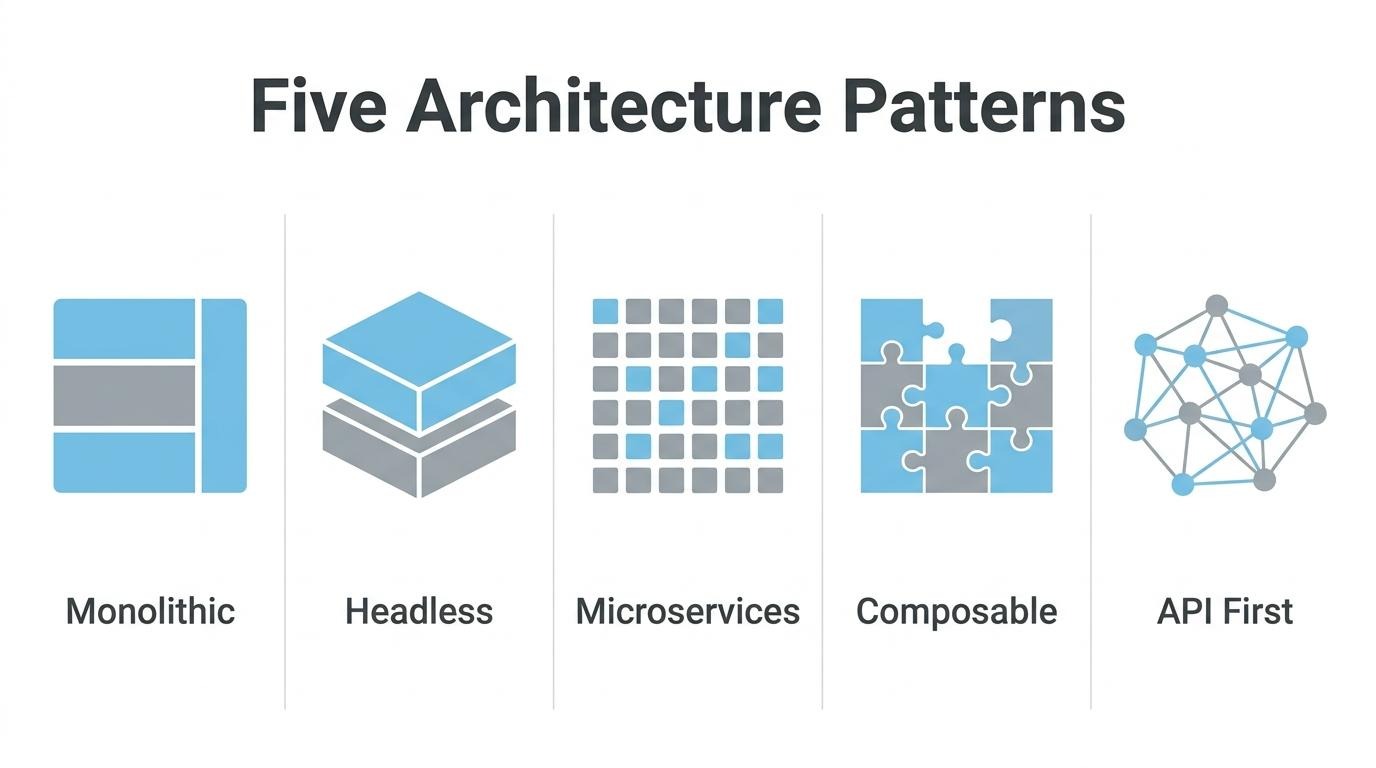
Monolithic architecture is a single, unified codebase where all commerce functions exist within one application. The storefront, business logic, database, and integrations are tightly coupled. This pattern simplifies initial deployment and reduces coordination overhead for smaller catalogs. However, scaling individual components independently becomes difficult as order volumes grow, and a single failure can cascade across the entire system. For enterprises with complex, multi-region requirements, monolithic platforms often become bottlenecks that slow feature releases and limit customization.
Headless commerce architecture decouples the front-end presentation layer from the back-end commerce engine. The storefront communicates with commerce services through APIs, allowing teams to build custom buyer experiences without modifying core logic. This decoupled architecture enables B2B enterprises to deploy unique interfaces for different buyer segments, portals, or devices while maintaining a single commerce backbone. Synonymous terms include modular commerce, decoupled architecture, and unified commerce. For brands managing both B2B portals and DTC storefronts, the headless approach allows each channel to evolve independently without creating technical debt in the underlying platform.
Microservices architecture breaks commerce functionality into small, independently deployable services. Each service handles a discrete function, such as pricing, inventory, search, or order management. Teams can update or scale one service without redeploying the entire system. This pattern suits enterprises processing high-volume orders across multiple regions because individual services scale horizontally based on demand. The trade-off is operational complexity; orchestrating dozens of services requires robust DevOps, monitoring, and service mesh infrastructure that smaller teams may struggle to maintain effectively.
Composable commerce architecture assembles best-of-breed components into a custom technology stack through standardized interfaces. According to a 2024 Alokai report, 80% of ecommerce enterprise companies have considered or already moved toward composable architecture, with a current adoption rate of 41.67%. Seventy-two percent of retailers are switching to composable commerce to move away from outdated platforms. This pattern provides a balanced model between monolithic rigidity and microservices complexity, letting enterprises swap individual components without rebuilding the entire stack. For scaling brands, composable architecture reduces vendor lock-in while maintaining operational cohesion.
API-first architecture designs every system interaction around well-documented, versioned APIs before building any user interface or integration. APIs serve as the foundational contract between services, enabling ERP, CRM, PIM, and OMS systems to exchange data reliably. This pattern ensures that new channels, partners, or internal tools can connect to commerce capabilities without custom point-to-point integrations. For enterprises managing complex B2B workflows like contract-specific pricing and multi-level approval chains, API-first design future-proofs the platform against evolving integration demands.
With architectural patterns defined, the next consideration is how a unified data layer connects these components to support enterprise workflows.
A unified data layer supports enterprise B2B workflows by consolidating customer, order, and inventory data into a single source of truth. The sections below cover how shared data eliminates silos, reduces integration complexity, and improves accuracy.
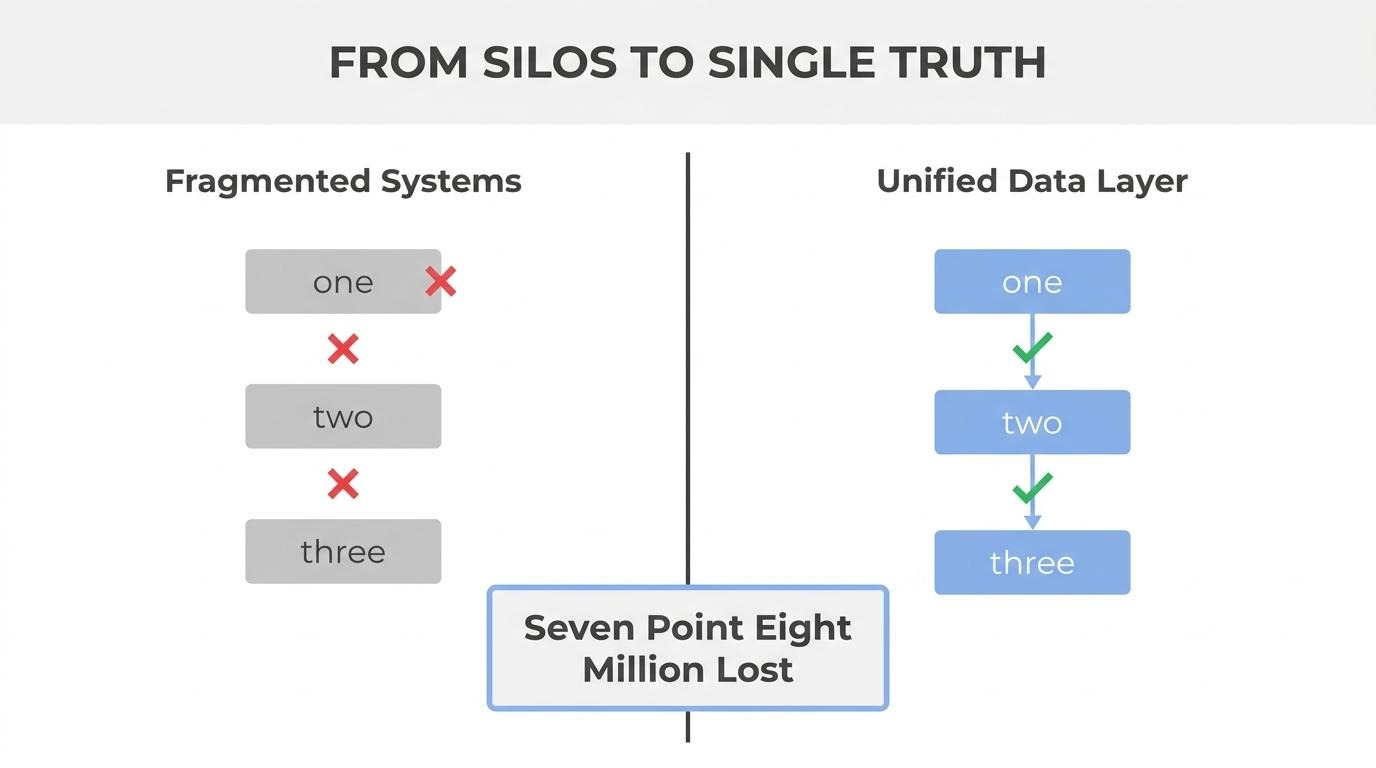
Shared customer data eliminates channel silos by resolving every buyer interaction to one record, regardless of where the transaction originates. According to McKinsey, B2B customers now use an average of ten interaction channels in their buying journey, up from five in 2016, and more than half want a true omnichannel experience. When each channel operates its own database, fragmentation compounds quickly.
The financial impact is severe. Companies lose between 20% and 30% of annual revenue due to inefficiencies caused by data silos, while the global economic cost reaches an estimated $3.1 trillion annually. Unified commerce architectures that break down silos between channels and operations enable seamless customer experiences and significant operational efficiencies.
For enterprises managing ten or more buyer touchpoints, treating unified customer data as infrastructure rather than a "nice-to-have" is the single highest-leverage investment before layering on automation or personalization.
A single data layer reduces integration complexity by providing one canonical data model that all systems reference, rather than requiring point-to-point connections between each tool. APIs enable integration between ERP, CRM, PIM, and OMS without custom middleware for every new connection. When unified systems reduce complexity in this way, enterprises avoid the cascading failures that fragmented architectures produce.
Multi-region B2B deployments illustrate the advantage clearly. Handling localized tax rules (VAT), GDPR compliance, and regional catalog variations within one data layer eliminates the need for separate integrations per market. Failed integrations cost organizations an average of $2.5 million in direct costs plus opportunity losses, according to Integrate.io, making architectural simplification a financial imperative rather than a technical preference.
Unified data improves order and inventory accuracy by synchronizing stock levels, pricing, and fulfillment status across every sales channel in real time. When a single data layer feeds the OMS, discrepancies between what the buyer sees and what the warehouse holds shrink dramatically.
According to Accio's analysis of Gartner projections, 60% of B2B sales organizations will transition to data-driven selling by 2025, leveraging AI and predictive analytics fed by unified datasets. Without clean, consolidated data, these models produce unreliable demand forecasts and misallocated inventory. For enterprises processing thousands of SKUs across regions, a shared data layer is what makes accurate, automated order orchestration possible rather than aspirational.
With unified data powering workflows, the next consideration is how APIs connect these systems at the integration layer.
APIs play the role of connective tissue in enterprise B2B ecommerce systems, enabling real-time data exchange between ERP, CRM, PIM, OMS, and CPQ platforms. The subsections below cover API-first adoption trends, how APIs eliminate revenue-draining data silos, and the performance gains they deliver for complex B2B data flows.
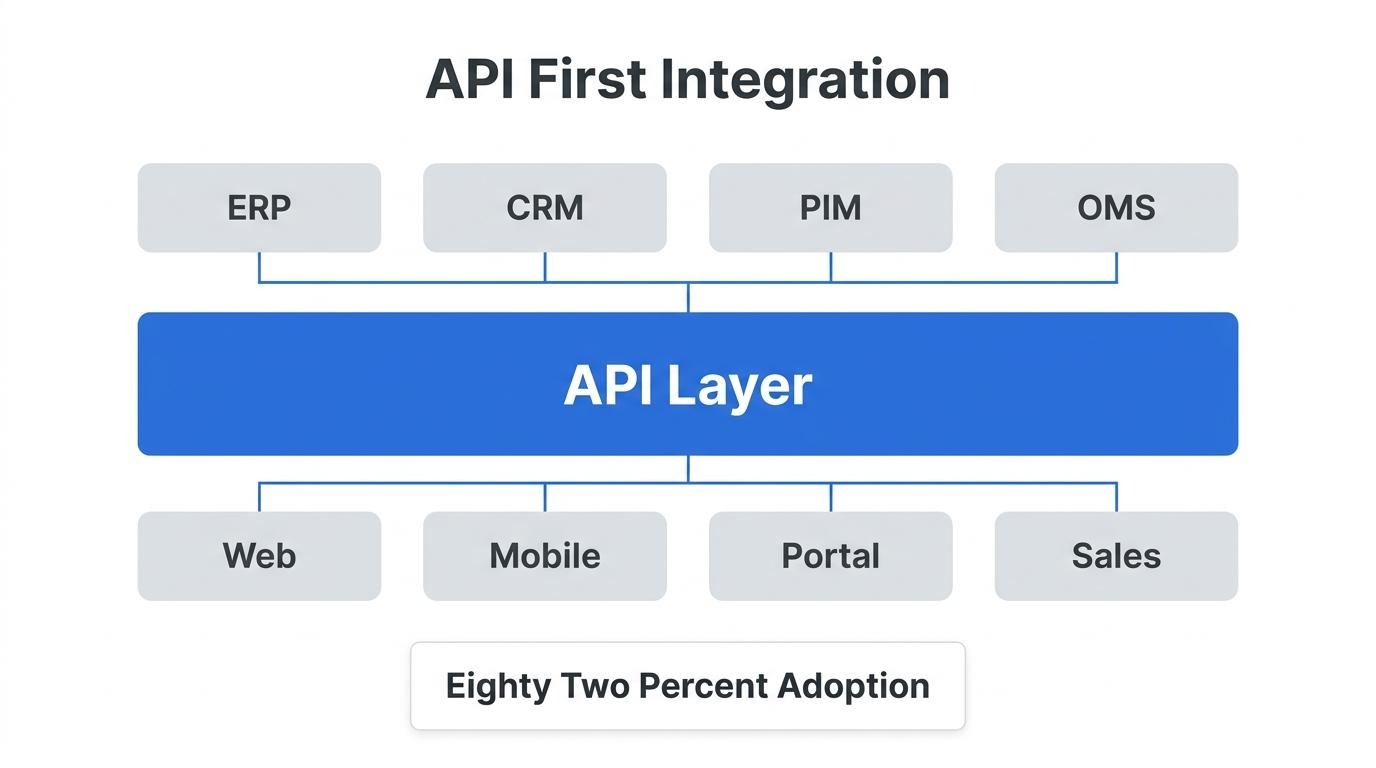
Enterprises are adopting an API-first strategy because it allows every system component to communicate through standardized, reusable interfaces before any front-end experience is built. According to Postman's 2025 State of API report, 82% of organizations have adopted some level of an API-first approach, with 25% operating as fully API-first organizations, representing a 12% increase from 2024.
This shift reflects a broader move away from monolithic platforms where integrations required custom code for each connection. An API-first architecture decouples services, letting enterprises swap or upgrade individual components without disrupting the full stack.
APIs connect ERP, CRM, and commerce platforms by serving as standardized data pipelines that synchronize customer records, inventory levels, pricing rules, and order status across systems in real time. Without this integration layer, enterprises face fragmented data across disconnected tools.
Key connections APIs enable between core systems:
For brands operating at scale with unified commerce needs, platforms that consolidate these connections into a shared data layer reduce the middleware complexity that typically compounds as businesses grow.
APIs deliver measurable performance gains for complex B2B data flows by reducing query latency and eliminating redundant data transformations between systems. A 2025 study published in the Journal of Multidisciplinary Research found that architecture supporting complex pricing logic through well-designed API layers can improve query performance by 64% for complex data flows.
This matters because B2B transactions involve multi-variable calculations, including tiered pricing, contract-specific discounts, volume breaks, and customer-specific catalogs. Each pricing request may pull data from multiple sources simultaneously. Well-architected APIs handle these parallel queries without bottlenecks, which is especially critical during high-volume ordering periods when thousands of authenticated buyers request personalized pricing concurrently.
With API-driven integration established, the next architectural challenge is managing the complex pricing and catalog logic these connections must support.
Architecture handles complex B2B pricing and catalogs by separating pricing engines, catalog logic, and customer segmentation into dedicated service layers that communicate through APIs. This section covers how pricing rules operate at the architectural level and how catalog structures adapt to enterprise buyer requirements.
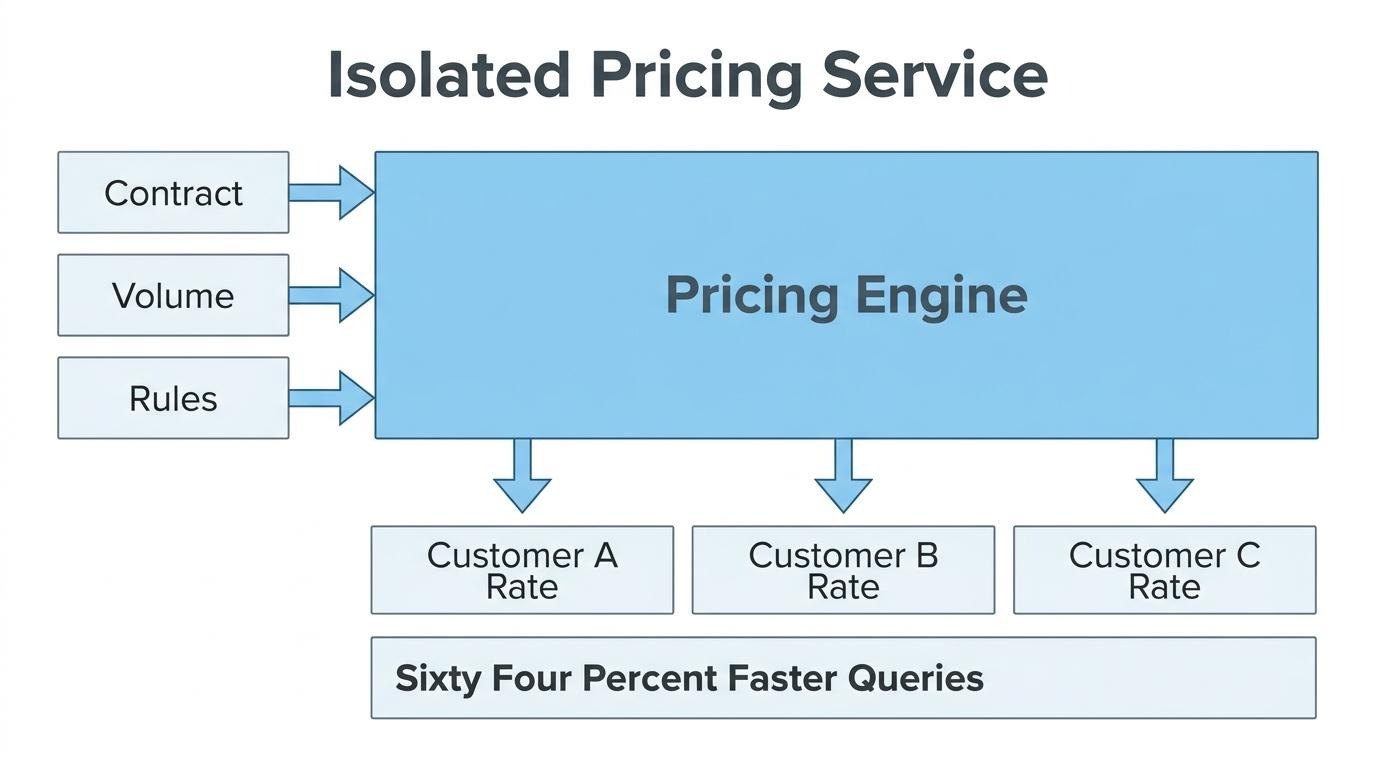
The pricing engine supports contract-specific and tiered logic by isolating pricing calculations into a dedicated service that references customer profiles, volume thresholds, and negotiated agreements independently of the storefront layer. This separation allows the system to evaluate multiple pricing rules simultaneously: contract rates for named accounts, volume-based tier breaks, and promotional overlays.
A CPQ (Configure, Price, Quote) module typically feeds into this engine, applying custom formulas per buyer segment without requiring manual intervention. According to a 2025 study published in the Journal of Multidisciplinary Sciences, architecture that supports complex pricing logic can improve query performance by 64% for complex data flows.
For enterprises managing thousands of negotiated contracts, this architectural isolation means pricing updates propagate instantly across all channels without redeploying the entire application.
Customer-specific catalogs work at the architecture level by linking product visibility rules to authenticated buyer profiles stored in the shared data layer. Role-based access control (RBAC) determines which products, pricing tiers, and inventory pools each buyer sees upon login.
The catalog service queries three inputs:
This architecture enables one product database to serve thousands of unique catalog views without duplicating data. Each authenticated session assembles its catalog dynamically, pulling only permitted SKUs and their associated negotiated prices.
Decoupling pricing from the storefront reduces operational friction because pricing changes no longer require front-end code deployments or full platform releases. Operations teams update pricing rules, discount structures, or contract terms directly within the pricing service, and those changes reflect immediately across web, mobile, and sales rep portals.
This separation eliminates a common bottleneck where merchandising depends on development cycles. When pricing logic lives inside a monolithic storefront, even small adjustments risk breaking unrelated functions. Isolated pricing services accept updates through admin interfaces or API calls without touching the presentation layer.
For brands managing both B2B and DTC channels from a single platform, this decoupled approach ensures wholesale pricing logic never leaks into consumer-facing experiences, keeping channel integrity intact.
Enterprise architecture must meet scalability requirements across order throughput, geographic distribution, and demand elasticity. The sections below cover high-volume processing, multi-region deployment, and seasonal spike management.
Architecture should handle high-volume order processing by distributing workloads across independently scalable services rather than routing all transactions through a single application layer. Microservices architectures isolate order ingestion, inventory checks, and payment processing into discrete services that scale horizontally under load. Monolithic systems, by contrast, require scaling the entire application even when only one function faces throughput pressure. This distinction becomes critical when enterprises process thousands of concurrent B2B orders with complex line items, multi-level approvals, and contract-specific pricing rules. Decoupled order services reduce queue bottlenecks and maintain sub-second response times at peak volume.
Architecture supports multi-region deployment by distributing infrastructure, data, and business logic across geographically distinct environments while maintaining a unified operational view. Key capabilities include:
Each region operates with low-latency local resources, yet a shared data layer synchronizes customer records, inventory, and order history globally. For brands operating at scale across the U.S. and international markets, this architecture prevents the common trap of running disconnected regional storefronts that fragment customer data.
The system scales during seasonal demand spikes through auto-scaling infrastructure that provisions additional compute, memory, and network capacity in response to real-time traffic signals. Cloud-native architectures monitor request queues and CPU utilization, then spin up additional service instances within seconds. This elastic approach means enterprises avoid over-provisioning expensive infrastructure year-round just to handle two or three peak periods. Load balancers distribute incoming requests across healthy instances, while CDN layers cache static assets closer to buyers. For B2B enterprises running annual contract renewals, fiscal year-end ordering surges, or promotional events, elastic scaling ensures checkout availability without degrading the complex pricing and approval logic that distinguishes B2B transactions.
With scalability addressed, the next consideration is how architecture secures these distributed systems.
B2B ecommerce architecture addresses security and compliance through layered controls, including encryption protocols, role-based access, and adherence to industry certification standards such as SOC 2 and PCI DSS.
Enterprise buyers impose strict security requirements before approving vendor platforms. According to a 2024 report by UnderDefense, seventy-eight percent of B2B buyers require SOC 2 compliance for enterprise SaaS sales, underscoring how information security certifications have become a gating factor in procurement decisions. PCI DSS 4.0, which became mandatory in 2025, introduced 51 new requirements focused on customized controls and stronger authentication protocols, raising the baseline for any platform handling payment data.
Architecturally, these demands shape system design in several ways:
The financial stakes reinforce why architecture must prioritize security from the foundation. IBM reported that the average cost of a data breach reached a record $4.88 million in 2024, a 10% increase over the prior year. For B2B platforms managing contract-specific pricing, customer-specific catalogs, and multi-region deployment, a single breach can erode buyer trust permanently.
Compliance is not a feature bolted on after launch; it is a structural requirement that influences how data flows between ERP, CRM, and OMS integrations. Platforms that treat security as an architectural principle rather than an afterthought reduce audit friction and accelerate enterprise sales cycles.
With security foundations established, integration challenges across fragmented tool stacks introduce their own operational risks.
Enterprises face integration challenges that include data silos between disconnected systems, failed synchronization across ERP, CRM, and OMS platforms, and compounding costs from maintaining multiple point-to-point connections. These issues erode revenue, slow operations, and create inconsistent customer experiences.
The financial impact is severe. According to a 2024 analysis by Integrate.io, failed integrations cost organizations an average of $2.5 million in direct costs plus opportunity losses, while data silos cost organizations $7.8 million annually. When each tool operates on its own data model, reconciling inventory counts, pricing rules, and customer records across systems becomes a persistent operational drain.
Common integration challenges fragmented tool stacks create include:
For brands operating at scale, the compounding effect is what makes fragmented architecture particularly costly. Each new channel, region, or product line multiplies the number of integration points exponentially rather than linearly. Organizations often discover that the total cost of maintaining ten separate tools exceeds the cost of a consolidated system, once middleware licensing, developer hours, and data-quality remediation are factored in.
This is precisely why architectural decisions made early determine whether growth adds complexity or compounds efficiency. When commerce, CRM, and operations share a single data layer, these integration challenges largely disappear at the infrastructure level rather than being patched at the application level.
Architecture should support omnichannel B2B and DTC selling by maintaining a single commerce layer that serves wholesale buyers and direct consumers from one shared data model, pricing engine, and inventory pool.
According to a 2025 Digital Commerce 360 report, 84% of B2B buyers state that integrated omnichannel experiences are important when selecting sellers. This expectation now extends beyond B2B into hybrid operations where a brand sells both wholesale and direct-to-consumer through the same platform. McKinsey research found that B2B customers use an average of ten interaction channels in their buying journey, up from five in 2016, with more than half of respondents wanting a true omnichannel experience.
Meeting this demand requires architecture that resolves several structural challenges:
When these layers fragment across disconnected tools, the cost compounds quickly. Organizations running siloed systems lose operational speed and data accuracy every time a channel-specific update fails to propagate. For brands operating at scale across both B2B and DTC, the architecture must treat omnichannel not as a feature bolted onto one selling mode, but as a foundational design constraint that shapes how every service communicates.
With omnichannel architecture established as a structural requirement, the next consideration is what changes operationally when commerce, CRM, and marketing consolidate into a single system.
Consolidating commerce, CRM, and marketing into one system eliminates data silos, reduces integration overhead, and creates a single customer record across channels. The following sections cover how SHOPLINE approaches this unification and the key architectural takeaways for enterprise B2B operations.
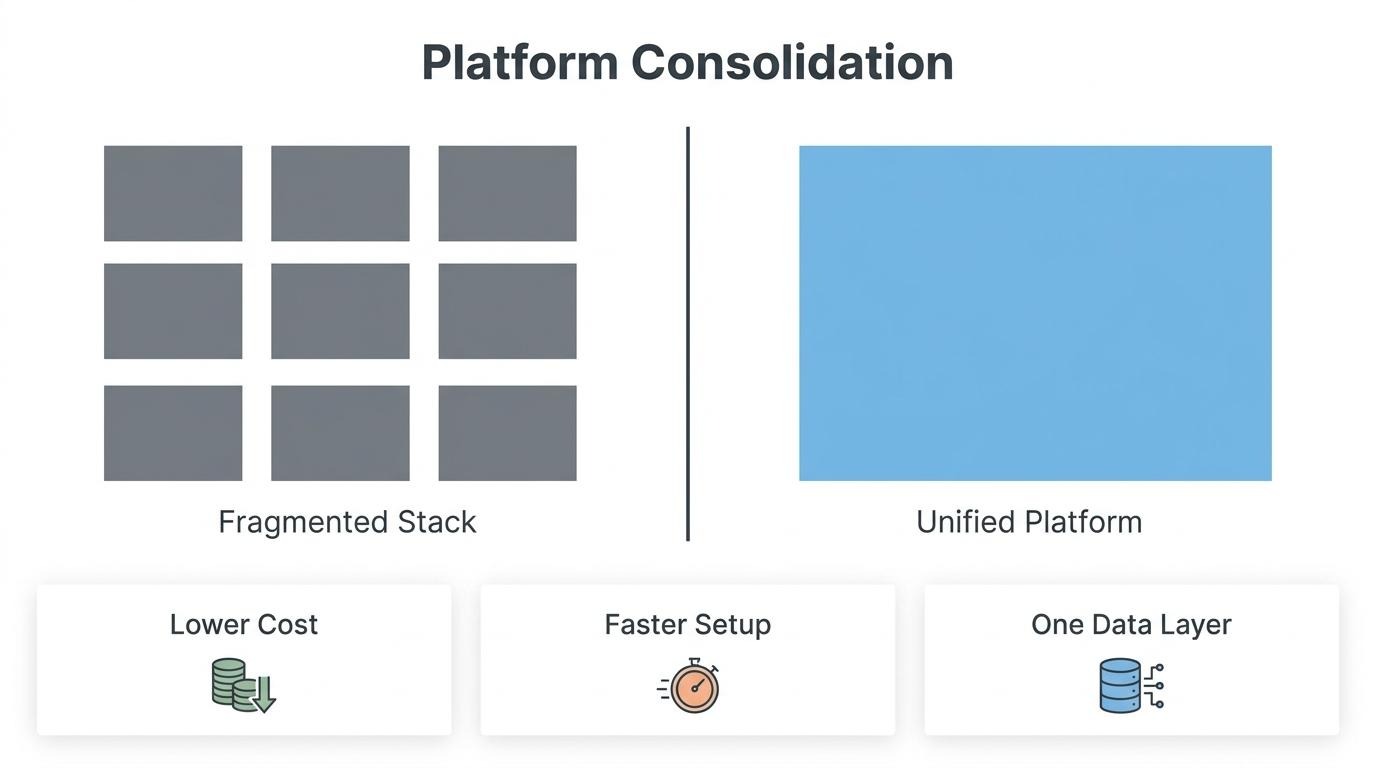
SHOPLINE handles enterprise data unification by running commerce, CRM, marketing automation, subscriptions, and POS inside a single platform with a shared customer data layer. Rather than reconciling separate tools through middleware or custom API bridges, every transaction, interaction, and lifecycle event resolves to one customer record.
This architecture removes the sync failures common in multi-tool stacks where order data lives in one system, email engagement in another, and offline POS transactions in a third. For brands operating at $1M to $50M+ in annual revenue, this consolidation reduces both the direct costs and the opportunity losses that fragmented integrations typically create.
The key takeaways about how B2B ecommerce software architecture supports enterprise are:
According to a 2025 study published in the Journal of Multidisciplinary Research, architecture supporting complex pricing logic can improve query performance by 64% for complex data flows. For enterprise teams evaluating platforms, the architectural decision is ultimately a consolidation decision: fewer integration points mean fewer failure points, faster execution, and cleaner data feeding every downstream system.